Last Updated: May 26, 2026
Vibe coding is quickly becoming the phrase that captures how AI-assisted programming feels when it really works: fast, conversational, and surprisingly fun.
Instead of wrestling with syntax and boilerplate, you describe what you want, iterate in natural language, and let powerful AI tools help with the heavy lifting. As leaders like Sundar Pichai have noted, this style of development is changing how people think about code and opening the door for more founders, product managers, and designers to ship real software.
For AI-first startup founders and non-technical founders, vibe coding is more than a buzzword. It’s a practical way to:
- Build MVPs quickly without a big engineering team
- Reduce time spent on repetitive coding tasks
- Keep focus on product, not infrastructure
- Avoid early, expensive DevOps decisions
In this article we’ll unpack what vibe coding really is, how it fits into modern software development, and how to pair it with the right backend infrastructure so you don’t trade speed today for technical debt tomorrow.
Understanding Vibe Coding
What is vibe coding?
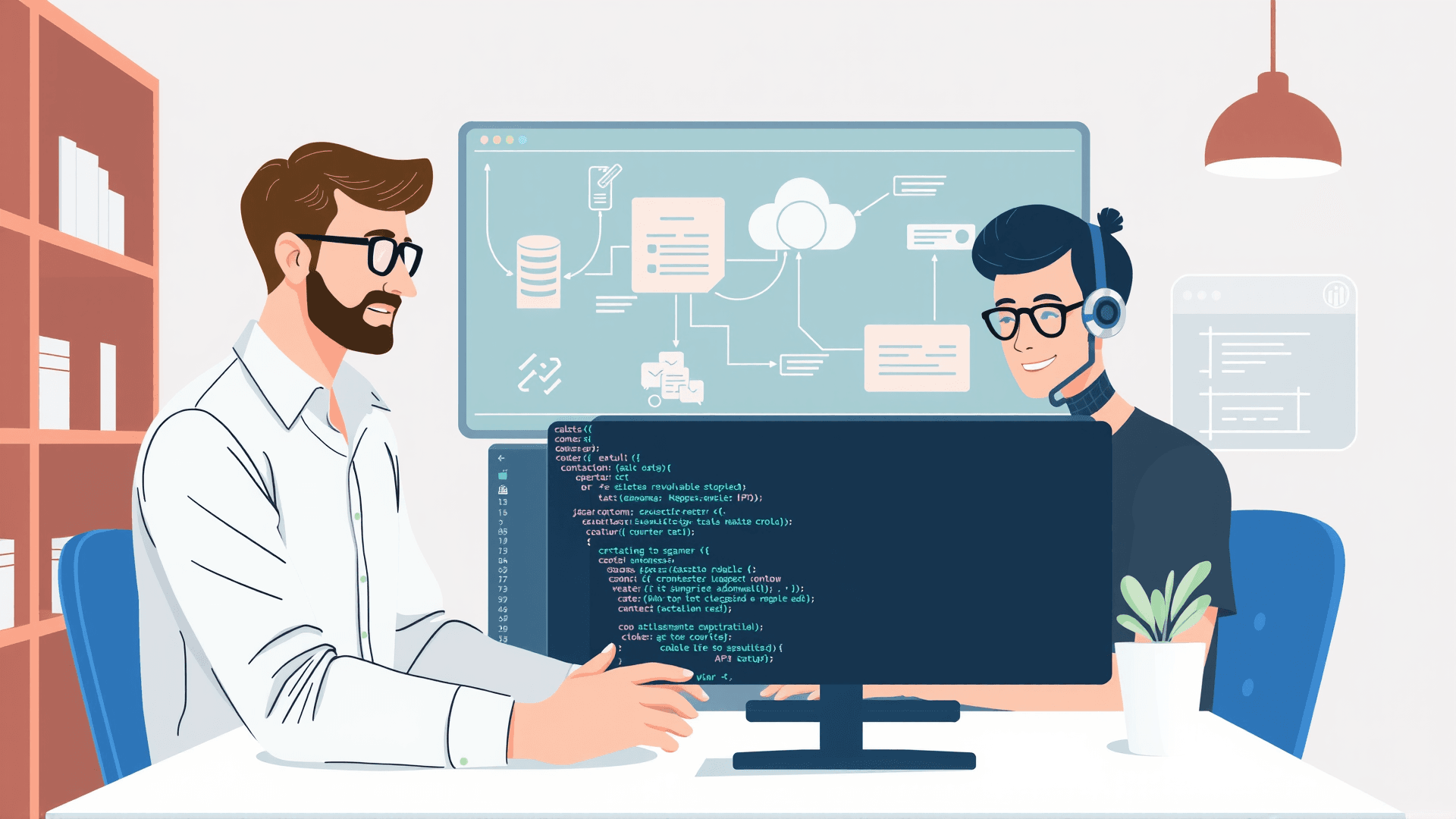
Vibe coding is a style of development where you:
- Talk to your tools in natural language (chat prompts, inline comments, voice in some cases)
- Iterate conversationally-“make this faster”, “add pagination”, “explain this query”
- Combine code generation and debugging in a single feedback loop
- Rely on AI as a pair programmer, not just a snippet search engine
Practically, it combines:
- Code-aware chat (e.g., explaining functions, suggesting refactors)
- In-editor assistance (autocomplete, code generation, tests, docs)
- Real-time feedback on errors and edge cases
Tools like GitHub Copilot and similar assistants have popularized this pattern, turning the editor into a collaborative environment rather than a static text box.[1]
What makes it a “vibe” rather than just “AI coding” is the qualitative shift: coding feels more like exploring ideas than fighting the compiler.
Benefits for developers
For both new and experienced developers, vibe coding changes the feel of the work.
1. Lower barrier to entry
Beginners or non-technical founders can:
- Start with intent (“build a REST API for tasks with auth”)
- Let AI scaffold the initial code and folder structure
- Ask for explanations in plain language when they get stuck
This doesn’t remove the need to learn fundamentals, but it removes the initial wall of complexity that usually blocks people from shipping.
2. Faster paths from idea to prototype
For early-stage founders, the key question is: How quickly can we test this idea with real users?
With vibe coding, you can:
- Generate boilerplate for routes, data models, and tests
- Iterate quickly on copy, prompts, or flows
- Use AI to wire up basic frontend-backend calls without memorizing every framework API
3. More focus on product, less on plumbing
As AI handles repetitive tasks-validation logic, error handling patterns, CRUD routes-you can:
- Spend more time on UX, business logic, and differentiation
- Make more informed product trade-offs earlier
- Keep your stack simpler, because you’re not optimizing for edge-case performance on day one
The Role of AI Tools in Modern Programming
How AI simplifies coding
Modern AI tools for coding typically combine several capabilities:
- Autocomplete & code synthesis - Predicting the next lines or entire functions based on context
- Natural-language-to-code - Turning a description into a function, query, or endpoint
- Context-aware refactoring - Suggesting safer or simpler alternatives
- Testing & documentation generation - Proposing unit tests, comments, and README sections
GitHub reports that developers using Copilot can complete tasks significantly faster and stay “in flow” for longer stretches of time.[1] Similar patterns are echoed in research from Microsoft and others.[2]
For AI-first teams, the practical impacts include:
- Reducing setup time for new services, endpoints, and data models
- Standardizing patterns across the codebase via AI-generated scaffolds
- Making cross-functional work easier, since non-specialists can propose or review code with AI guidance
Impact on productivity
Quantitatively, multiple surveys and reports point in the same direction:
- Stack Overflow’s Developer Survey shows a fast-growing share of developers using AI assistants regularly, especially for mundane tasks and boilerplate.[3]
- McKinsey notes that effective developer tools can unlock substantial productivity gains and shorten time-to-market for digital products.[2]
In day-to-day terms, vibe coding can help you:
- Shorten feedback loops - You get suggestions and corrections in seconds
- Reduce context switching - Less bouncing between docs, Stack Overflow, and your editor
- Ship more experiments - When code is cheaper to write, you’re more willing to test ideas
But there are trade-offs:
- AI suggestions can be confidently wrong or subtly insecure
- Generated code can mask complexity, tempting teams to ship without fully understanding
- Sending code to third-party AI services raises privacy and compliance questions, especially in Europe
The solution is not to avoid AI, but to use it deliberately, with clear boundaries and a solid backend strategy.
Enhancing Developer Experience
User-friendly tools for beginners
For beginners or non-technical founders, the traditional developer experience is rough:
- Steep learning curves for frameworks and deployment
- Cryptic error messages
- Complex local setups and DevOps overhead
Vibe coding softens this by:
- Letting you ask “why?” on any line and get an immediate explanation
- Providing guided debugging-“What’s wrong with this function?”
- Helping you translate plain language into working code, then iterating from there
A good starter workflow might look like:
- Describe your feature in natural language.
- Let your AI assistant generate initial code.
- Ask it to explain the key parts.
- Run it, capture errors, and paste them back into the assistant for fixes.
Think of it as interactive learning-by-building, not passive tutorial consumption.
Benefits for experienced programmers
For senior developers, vibe coding is less about learning and more about leverage:
- Offloading mechanical work - Generating repetitive patterns, migrations, or test cases
- Exploring alternative designs - “Propose a functional version of this class-based code”
- Refactoring legacy code - Using AI to propose safer, smaller-step refactors
However, experienced developers must also be the ones to enforce guardrails:
- Always review AI-generated code with the same scrutiny as a junior PR.
- Add tests before and after big AI-assisted refactors.
- Watch for performance and security regressions introduced by “clever” suggestions.
A practical checklist many teams adopt:
Vibe Coding Checklist for Production Code
- Never auto-commit AI-generated code without review
- Require tests for non-trivial AI-introduced logic
- Keep API keys, secrets, and customer data out of prompts
- Log which files were heavily AI-generated for future audits
- Run security linters and dependency checks regularly
Used this way, vibe coding becomes a force multiplier, not a gamble.
The Future of Software Development Culture
Evolution of coding practices
As AI becomes embedded in editors, IDEs, and cloud tooling, we’re seeing a cultural shift:
- From “lone wizard” to “pairing with an AI” - The default mode becomes collaborative
- From memorizing APIs to specifying intent - You focus on what the system should do, not how every component is wired
- From monolithic releases to continuous experiments - Faster coding plus AI-driven analytics encourages more iteration
Developer tooling is catching up to this reality. Major ecosystems now offer:
- Built-in AI assistance in IDEs
- Code-aware search across repos
- Automated test and deployment pipelines designed around high-change codebases
The shift towards creativity
When the cost of writing code drops, a couple of interesting things happen:
- Non-traditional voices enter the conversation-designers, PMs, domain experts contribute more directly to implementation
- Teams are more willing to play with ideas, because it’s cheap to try and cheap to throw away
- The bottleneck moves from raw coding time to product thinking, data strategy, and infrastructure choices
That last point is crucial. Vibe coding can help you spin up features quickly, but you still need:
- A backend that can grow with you
- Data handling that respects GDPR and customer trust
- Observability, logging, and error handling that AI can’t magically improvise later
For European startups in particular, data residency and compliance are not “nice to have”. The GDPR framework makes clear that controllers are responsible for where and how data is processed and stored.[4]
From Vibe Coding to Real Users: Backend Choices That Don’t Hurt Later
It’s one thing to vibe code a prototype; it’s another to run a real product with paying customers, SLAs, and compliance requirements.
Many AI-first teams run into the same pattern:
- Use AI tools to spin up a quick backend (often on a free-tier service).
- Hard-code a bunch of logic directly into routes or serverless functions.
- Accumulate silent complexity in auth, migrations, and background jobs.
- Hit scaling, cost, or compliance walls just as the product starts working.
To keep the vibe coding experience while avoiding this trap, you want a backend that is:
- AI-friendly - Easy for AI tools to understand and generate code for (clear APIs, well-known stack)
- No-DevOps by design - So you don’t need a dedicated infra team just to keep things online
- Auto-scalable - Handling traffic spikes without sudden rewrites
- Open and portable - Avoiding deep vendor lock-in as your needs mature
- Data-sovereign - Especially if you operate in or serve customers in the EU
Parse Server-an open-source backend framework-fits this bill well for many startups because it offers:
- Authentication, database, files, and real-time subscriptions out of the box
- A simple, consistent API surface that AI assistants can easily learn and generate code for
- The option to move between providers or self-hosting if your strategy changes
Platforms like SashiDo, which provide fully managed Parse Server hosting on 100% EU infrastructure, are designed to pair naturally with vibe coding workflows:
- Your AI assistant can generate Cloud Code functions, background jobs, and triggers in JavaScript.
- You get real-time database subscriptions, push notifications, and web hosting without standing up separate services.
- Auto-scaling and no hard request limits mean you can test growth without rewriting your backend early.
- Direct MongoDB access lets experienced developers dive deeper when needed, while still shielding founders from day‑to‑day operations.
For AI-first startups, this means you can:
- Use AI assistants to accelerate backend development
- Keep your stack on battle-tested, open-source foundations
- Maintain GDPR-native data handling by keeping infrastructure inside the EU
If you’re looking for a backend that matches the speed and flexibility of vibe coding-without forcing you into heavy DevOps or vendor lock‑in-it’s worth taking time to explore SashiDo’s platform, which provides auto-scalable Parse Server hosting, real-time features, and AI-ready infrastructure on an EU-first footprint: AI-ready backend infrastructure for modern apps.
Conclusion: The Real Promise of Vibe Coding
Vibe coding isn’t about replacing developers with AI; it’s about making coding experience more collaborative, playful, and accessible-especially for founders and small teams who don’t have the luxury of large engineering departments.
Used well, vibe coding:
- Speeds up ideation and experimentation
- Lowers the barrier for non-traditional coders
- Frees experienced engineers to focus on architecture and quality
But the fundamentals haven’t changed:
- You still need to understand your data model and core flows.
- You still need a backend that can scale, remain compliant, and avoid vendor traps.
- You still need humans making judgment calls about security, performance, and trade-offs.
The teams that will win in this new era of AI-assisted programming are those that:
- Embrace vibe coding as a productivity and creativity boost
- Combine it with solid, scalable backend platforms that minimize DevOps overhead
- Treat AI as a powerful assistant, not an excuse to skip engineering discipline
If you can get those pieces right, vibe coding becomes more than a trend-it becomes the default way your team builds, learns, and ships software.
-
GitHub Copilot overview - AI pair programming assistant: https://github.com/features/copilot ↩↩
-
McKinsey, "Developer productivity: The key to digital transformation": https://www.mckinsey.com/capabilities/mckinsey-digital/our-insights/developer-productivity ↩↩
-
Stack Overflow Developer Survey 2024 - attitudes toward AI tools in development: https://survey.stackoverflow.co/2024 ↩
-
GDPR.eu, "What is GDPR?": https://gdpr.eu/what-is-gdpr/ ↩
