Last Updated: April 07, 2026
Modern mobile apps look simple on the surface: a few screens, a login flow, some data. Underneath, you are juggling authentication, data sync, push notifications, business logic, scaling resources. That is where mobile backend as a service (MBaaS) earns its keep.
Rather than provisioning servers, setting up databases, and managing infrastructure yourself, MBaaS gives you plug-and-play backend capabilities like auth, storage, real-time APIs, background jobs, and more. The payoff? Faster shipping, less DevOps stress, and performance that scales with security under control.
This article walks through how mobile backend as a service works, what to look for in a platform, common pitfalls to avoid, and how to design a backend that can scale from side project to serious product.
Understanding Mobile Backend as a Service
At a high level, a mobile backend as a service gives you a managed stack for common backend needs:
- User and session management
- Database and file storage
- Server-side business logic
- Real-time data and push notifications
- Operational basics (monitoring, logging, scaling)
You interact with it through SDKs or HTTP APIs from your mobile app. The provider operates and scales the underlying infrastructure.
MBaaS vs. traditional backends
With a traditional backend you would typically:
- Provision servers or containers on a cloud provider
- Choose and configure databases, queues, caches
- Implement mobile backend authentication (sessions, tokens, password reset, social login)
- Maintain CI/CD, observability, backups, and security patches
That approach gives you maximum control but also maximum responsibility. Every new feature has an infrastructure tax.
With MBaaS, much of this is pre-built:
- Auth flows, password reset, email verification, and role-based access control are ready to use
- Data models and APIs can be defined in a dashboard or via schemas
- Cloud functions let you run custom code without managing servers
- The platform handles availability, security patches, and auto-scaling
For many mobile teams-especially indie devs and small companies-this trade-off is worth it: less flexibility at the infrastructure level in exchange for dramatically lower operational load and quicker iterrations.
Where Parse Server fits
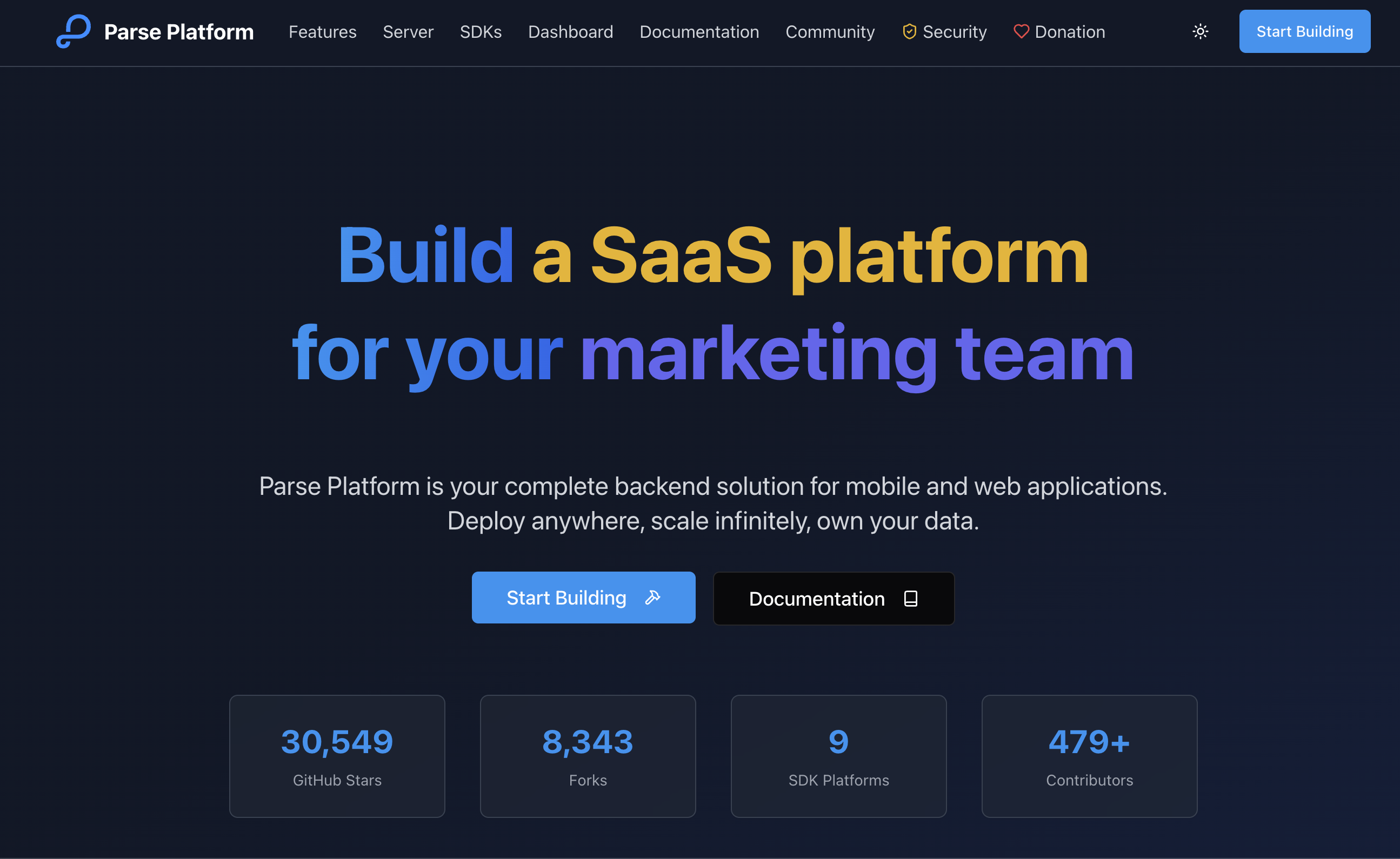
Parse Server is an open-source backend framework that powers many MBaaS platforms. It provides:
- A schema-aware data model
- User and session management
- Cloud Code (server-side functions)
- File storage abstractions
- Real-time LiveQuery subscriptions
Because it is open source, you can self-host Parse Server or use a managed provider. This no vendor lock-in path is attractive: you can start with a hosted service provider like SashiDo and, if your needs change, move to your own infrastructure without rewriting your app from scratch.
Here's how this works in practice:
Starting with a managed provider (SashiDo):
// Initialize Parse SDK with SashiDo
Parse.initialize(
  "YOUR_APP_ID",
  "YOUR_JAVASCRIPT_KEY"
);
Parse.serverURL = "https://your-app.scalabl.cloud/1";

// Create and save a user
const user = new Parse.User();
user.set("username", "alice");
user.set("email", "alice@example.com");
user.set("password", "secure-password");
await user.signUp();

// Query data with real-time subscriptions
const query = new Parse.Query("Post");
const subscription = await query.subscribe();
subscription.on("create", (post) => {
  console.log("New post:", post.get("title"));
});
Migrating to self-hosted Parse Server:
If you later decide to self-host, your client code remains identical, only the configuration changes:
// Same Parse SDK, different server URL
Parse.initialize(
  "YOUR_APP_ID",
  "YOUR_JAVASCRIPT_KEY"
);
Parse.serverURL = "https://your-own-domain.com/parse";

// All existing queries, user management, and Cloud Code work unchanged
const user = new Parse.User();
user.set("username", "alice");
user.set("email", "alice@example.com");
user.set("password", "secure-password");
await user.signUp();
Self-hosted Parse Server setup:
// server.js - Your own Parse Server instance
const express = require("express");
const ParseServer = require("parse-server").ParseServer;

const api = new ParseServer({
  databaseURI: "mongodb://localhost:27017/myapp",
  cloud: "./cloud/main.js",
  appId: "YOUR_APP_ID",
  masterKey: "YOUR_MASTER_KEY",
  serverURL: "https://your-own-domain.com/parse",
  liveQuery: {
    classNames: ["Post", "Comment"] // Enable real-time for specific classes
  }
});

const app = express();
app.use("/parse", api);
app.listen(1337, () => console.log("Parse Server running"));
This portability means you can start fast with managed infrastructure and retain full control over your migration path.
Real-time apps on MBaaS
Many modern apps need real-time features: chats, presence indicators, collaborative editing, live dashboards, or in-app notifications. Implementing this from scratch requires WebSockets, message brokers, and careful scaling.
MBaaS platforms with real-time support abstract this away by providing:
- Subscriptions to data changes (e.g., LiveQueries)
- Push notification APIs (for iOS and Android)
- Triggers on create/update/delete events to run custom logic
This lets you build real-time apps with much less backend complexity.
Essential Features of a Strong Mobile Backend
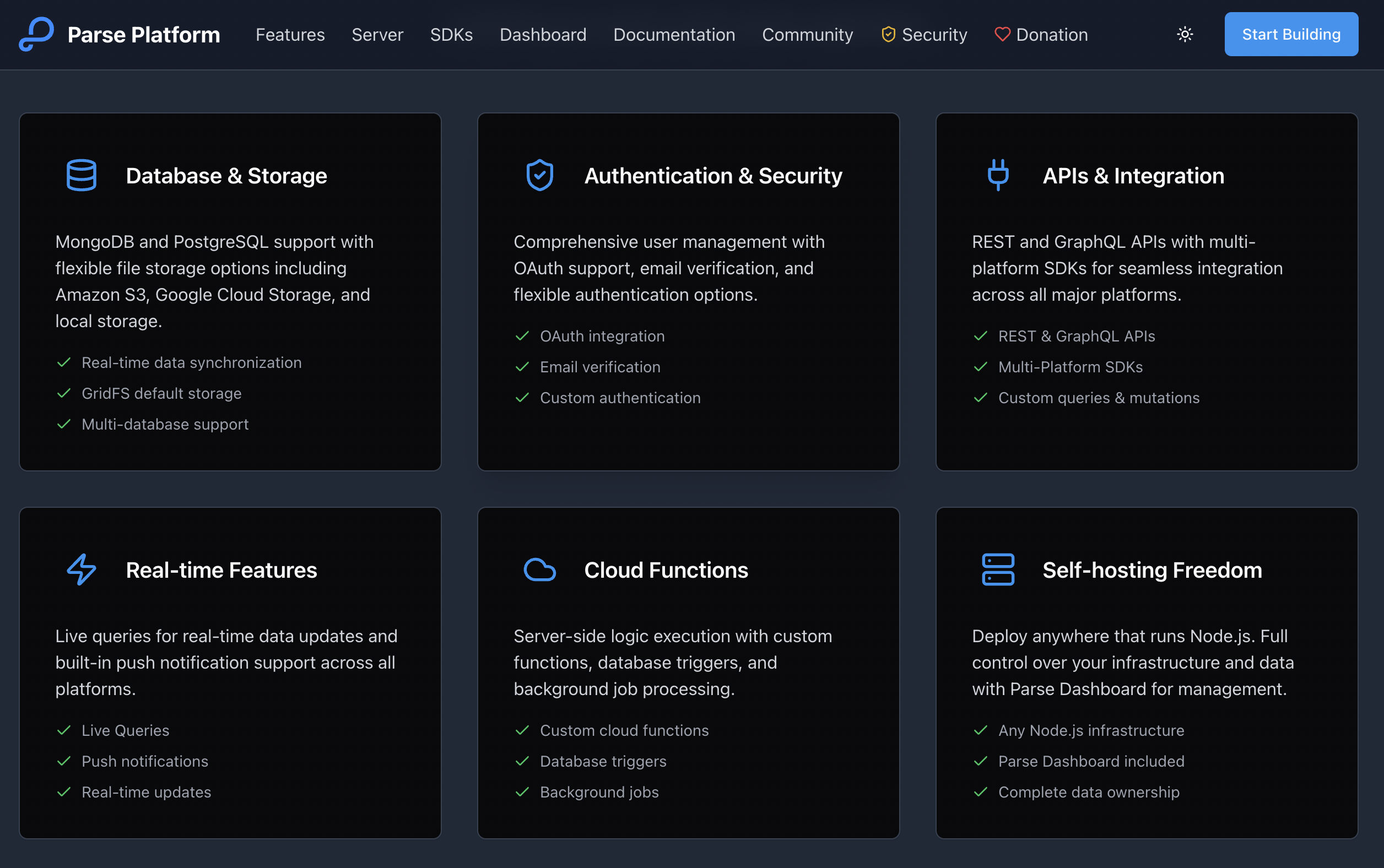
Regardless of which tech stack you pick, a strong mobile backend should cover a few essentials very well.
1. Robust mobile backend authentication
Authentication is usually the first thing users see and one of the hardest things to get right securely.
Look for features like:
- Email/password login with secure password hashing
- OAuth and social login (Apple, Google, etc.)
- Multi-factor authentication options
- Session and token management (JWT or opaque tokens)
- Role- and attribute-based authorization
Following security guidance such as the OWASP Mobile Top 10 is much easier when the platform bakes good practices into its auth system.
2. Flexible, scalable data storage
Your backend should provide a data model that is:
- Expressive enough for your domain (relations, arrays, geo, etc.)
- Optimized for mobile access patterns (paginated queries, partial fetches)
- Backed by a mature database, such as MongoDB or a relational engine
If the underlying database is something like MongoDB, make sure you understand the basics-indexes, document design, and query patterns. The official MongoDB documentation is a good resource for that.
For example, SashiDo has a Built-in Database Browser, that gives you easy access to your database and allows you to maintain and update your records effortlessly. You can add, delete, sort, filter, query, classify, or edit data without any programming skills needed.
3. Real-time sync and offline support
Mobile networks are flaky. Users switch between Wi‑Fi and cellular, go through tunnels, or use your app on planes. A good mobile backend helps by offering:
- Real-time subscriptions to changes
- Efficient sync protocols to minimize bandwidth
- Conflict resolution strategies (last-write-wins, merge, server authority)
- Hooks to support offline-first patterns (local cache, retry queues)
Platforms like Firebase popularized this for mobile, but the same patterns apply regardless of provider.
4. Cloud functions and background jobs
You will inevitably need code that should not run on the client:
- Payment webhooks
- Fraud checks
- Data aggregation and reporting
- Scheduled cleanups and maintenance tasks
Look for features such as:
- Request/response cloud functions called from the client
- Triggers on data changes
- Scheduled or repeatable background jobs
- Secure environment variable management
This function layer is the glue between your mobile app and external APIs.
5. No vendor lock-in
Vendor lock-in becomes painful once your app is successful. To mitigate it, prioritize:
- Open-source core (for example, providers like SashiDo, that are using Parse Server as the backend runtime)
- Standard protocols (REST, GraphQL, WebSockets)
- Easy data export (MongoDB connection strings, database dumps)
- The option to self-host or move providers later
You might never migrate-but designing for the option now makes future architectural decisions much less risky.
Choosing the Right Backend for Your Mobile App
Different projects need different levels of control, cost efficiency, and compliance. There is no single "best" backend, only trade-offs.
Key questions to ask
Before picking a stack, clarify:
- Team size and skills: Do you have backend and DevOps engineers, or mostly mobile/front-end developers?
- Time-to-market: Are you validating an MVP in weeks, or building a long-term platform?
- Compliance: Do you have GDPR, HIPAA, or industry-specific requirements?
- Traffic profile: Steady baseline, spiky usage, or large real-time workloads?
- Feature roadmap: How real-time, collaborative, and offline-first does this need to be?
Comparing common options
| Approach | Pros | Cons | Good fit for |
|---|---|---|---|
| DIY on cloud (e.g., raw AWS/GCP) | Maximum flexibility, full control over infra | High DevOps overhead, longer setup time | Large teams, complex/custom requirements |
| Self-hosted Parse Server | Open source, no vendor lock-in, customizable | You manage scaling, monitoring, security | Teams with ops skills who want control |
| Hosted Parse-based MBaaS | Familiar Parse APIs, managed infra, easy migration options | Less low-level infra control | Mobile teams wanting fast delivery, minimal DevOps |
| Generic MBaaS (non-open-core) | Very fast to start, rich ecosystem | Stronger lock-in risk, harder migration | MVPs, small apps without strict compliance |
For many mobile teams, especially in Europe, a hosted Parse-based MBaaS with data residency controls and built-in auto-scaling offers a strong balance between convenience, flexibility, and compliance.
Avoiding Common Pitfalls in Backend Development
A lot of backend pain points are predictable. You can avoid many of them with a bit of upfront planning.
1. Over-engineering too early
It is tempting to start with microservices, event buses, and complex CQRS patterns. For most early-stage mobile products, this is overkill.
Start with:
- A single, well-structured application (monolith is fine)
- One primary database
- Clear boundaries in your code (modules or bounded contexts)
You can split services later if and when they become bottlenecks. MBaaS like SashiDo and Parse Server already encourage this by centralizing logic in Cloud Code and keeping your surface area manageable.
2. Rolling your own authentication
Auth looks easy-until it is not. Building your own login, session, and password reset flows often leads to:
- Weak password storage
- Insecure session handling
- Broken access controls
Use the provider's mobile backend authentication primitives wherever possible. Extend them with custom roles or scopes rather than starting from scratch. Combine this with guidance from OWASP and your organization’s security team.
3. Ignoring observability
If you cannot see what your backend is doing, you cannot debug production issues or optimize performance.
Look for (or build):
- Centralized logs with search and filtering
- Metrics on request rates, latency, error rates, and resource usage
- Alerts for error spikes and performance regressions
Even in a managed MBaaS environment, inspect logs and metrics regularly. Some providers like SashiDo even has automated recomendations and alerting when they catch performance patternns that need your attention, which is really helpful as it saves time and let's you take peventive measures where it matters. Use such prompts and tips to guide schema updates, index creation, and caching decisions.
4. Treating the database as a dumping ground
Unplanned schemas turn into performance problems later. With document stores like MongoDB, it is especially easy to just keep adding fields.
Better practices include:
- Designing collections around access patterns
- Adding indexes for common queries
- Avoiding extremely large documents
- Planning for migrations and data cleanup
The MongoDB data modeling docs are a great reference when you are unsure.
5. Underestimating privacy and compliance
If you have users in the EU or handle sensitive data, compliance should shape your backend design from day one.
- Understand GDPR basics and data subject rights. The overview at GDPR.eu is a good starting point. You can also check out SashiDo's guide on getting your app GDPR compliant.
- Prefer providers with clear data residency options and strong contractual guarantees.
- Implement data retention, deletion, and audit logging policies early.
MBaaS can help here by centralizing access controls and data flows instead of scattering them across ad-hoc services.
Scaling Your App with the Right Backend Infrastructure
Scaling is not just about handling more traffic; it is about doing so without collapsing under operational complexity.
Horizontal vs. vertical scaling
Most modern backends scale horizontally:
- App layer: multiple stateless instances behind a load balancer
- Database layer: read replicas, sharding, or partitioning
With MBaaS, the underlying auto-scaling logic is usually managed for you. The provider adjusts compute resources based on CPU, memory, or request volume.
For example SashiDo offers a nifty feature called Engines, which allows you control the numbers of your servers and eneble features like auto-scaling and High-Availability with a simple toggle.
Key things to verify:
- Are there hard request or connection limits?
- How does the platform handle traffic spikes?
- What are the latency and throughput guarantees (if any)?
Real-time workloads
Real-time features (chat, collaborative editing, live dashboards) introduce different scaling concerns than simple REST APIs:
- Long-lived WebSocket connections
- Higher fan-out for updates
- More frequent small writes
A Parse-based MBaaS like SashiDo has built-in LiveQueries or equivalent real-time subscriptions that can manage this pattern efficiently, but you should still:
- Use selective subscriptions (subscribe only to what you need)
- Paginate and limit queries
- Offload heavy computation to background jobs
Regional deployment and latency
If your users are concentrated in one geography, hosting your backend close to them improves latency.
For European apps, EU-only infrastructure helps not only with performance but also with regulatory alignment under GDPR. Combining regional hosting with clear data residency guarantees reduces legal and architectural risk as your user base grows.
Currently, on SashiDo's standard pricing plans you can choose from 2 server locations for hosting your app - North America(Montreal) and Europe(Paris). Dedicated resources are provided on Premium plans upon request. You can find out more on how to chooce your hosting region in this guide.
The Benefits of Serverless Architectures in Mobile Development
While MBaaS already abstracts much of the backend, serverless functions and workflows push this even further.
Why serverless pairs well with mobile apps
Mobile traffic is often spiky: a marketing campaign, launch day, or a regional event can create huge peaks. Serverless backends help by providing:
- Automatic scaling to zero and up to peak demand
- Pay-per-use pricing instead of paying for idle capacity
- Lower ops overhead, since you are managing functions, not servers
Whether you are using Parse Cloud Code, Node.js micro-functions, or another runtime, serverless patterns map nicely onto mobile use cases:
- Processing images or videos uploaded from devices
- Running webhooks from payment providers
- Sending transactional emails or push notifications
- Executing AI/ML inference for personalized experiences
Trade-offs to be aware of
Serverless is not a silver bullet. Be mindful of:
- Cold starts: Initial requests may be slower if functions have been idle
- Execution limits: Long-running tasks may need to move to background job systems
- Debugging complexity: Distributed logs and traces can be harder to reason about
- Platform-specific APIs: The deeper you go into proprietary features, the higher your migration cost
A balanced approach is to keep business logic in portable languages and runtimes, use open standards where possible, and choose providers that do not lock you into proprietary data stores.
A Practical Path: From Prototype to Production
To make this concrete, here is how you might evolve a mobile backend over time using an MBaaS and Parse Server-style capabilities.
-
Prototype (week 1-4)
-
Use a hosted MBaaS with ready-made user auth
- Define your core data classes (e.g., User, Post, Comment, Message)
- Implement screen-level logic relying on REST/SDK calls
-
Use push notifications and basic LiveQueries for real-time UX
-
MVP launch (month 1-3)
-
Add Cloud Code for complex validation and business rules
- Introduce scheduled jobs for cleanups and analytics rollups
- Tighten security by moving sensitive checks from client to server
-
Start monitoring key metrics and responding to performance issues
-
Growth stage (month 3+)
-
Optimize queries and indexes based on real traffic patterns
- Segment background jobs (e.g., high-priority vs. batch)
- Evaluate regional hosting and scaling limits
- Consider self-hosting Parse Server or multi-provider setups if you need deeper customization, while preserving existing APIs for your mobile apps
At each stage, the goal is the same: let the backend do as much heavy lifting as possible so your time goes into product, not plumbing.
If you like the idea of an open-source-based mobile backend as a service with strong support for Parse Server, real-time features, and AI-ready workloads-without taking on DevOps yourself-you can explore SashiDo’s platform to see how a managed backend with EU-focused infrastructure and auto-scaling can fit into your mobile stack.
Conclusion: Build Confidently with Mobile Backend as a Service
The backend of your mobile app is more than just an API-it is the engine that powers authentication, data, real-time experiences, and reliability under load. Building and operating that engine from scratch is possible, but rarely the best use of a small team’s time.
By leaning on mobile backend as a service platforms-especially those built on open technologies like Parse Server, and designed for no vendor lock-in-you offload undifferentiated heavy lifting while keeping the option to evolve your architecture later.
Focus on what your users actually see and care about: fast, reliable, secure experiences that feel effortless. Let a well-chosen backend handle the rest.
💡 Power Your App with SashiDo
SashiDo gives you the freedom of open-source Parse Server with powerful cloud infrastructure and dev tools built-in. Start building now - no credit card required.
Start Your Free Trial