
Last Updated: February 04, 2026
If you’re building an AI-first product, you’ll quickly face one foundational decision: Should your app use a RAG Pipeline or rely on more traditional LLM approaches?
For many founders and indie developers, the choice isn’t just about model quality. It’s about factual accuracy, knowledge management, real-time data, infrastructure complexity, and how much DevOps work you’re willing (or able) to take on.
In this guide, we’ll unpack how a RAG Pipeline works, how it differs from traditional LLMs, and what that means for your product architecture, costs, and roadmap.
Understanding RAG Pipelines
A RAG Pipeline (Retrieval-Augmented Generation) connects a large language model to external data sources such as documentation, internal knowledge bases, ticketing systems, or logs. Instead of asking the model to "remember everything," you let it retrieve relevant information at query time and generate grounded answers on top of that.
At a high level, RAG was popularized by research from Meta AI on retrieval-augmented language models that combine parametric and non-parametric memory for better factuality and generalization.¹
How RAG Pipeline Works
Most production-grade RAG architectures follow a similar flow:
1. Ingest & index content
1.1 Collect content from docs, PDFs, wikis, databases, logs, or APIs.
1.2 Chunk it into passages and store embeddings in a vector database (e.g., Pinecone, Weaviate, Qdrant).²
Example with SashiDo:
Use Parse Server's Cloud Code to ingest documents and generate embeddings, storing metadata in your Parse database while vectors go to Pinecone.
   // Parse Cloud Code for document ingestion
   Parse.Cloud.define("ingestDocument", async (request) => {
     const { content, title, source } = request.params;

     // Generate embedding using OpenAI
     const embedding = await generateEmbedding(content);

     // Store in Parse database
     const Document = Parse.Object.extend("KnowledgeBase");
     const doc = new Document();
     doc.set("title", title);
     doc.set("content", content);
     doc.set("source", source);
     await doc.save(null, { useMasterKey: true });

     // Store embedding in Pinecone
     await pineconeIndex.upsert([{
       id: doc.id,
       values: embedding,
       metadata: { title, source }
     }]);

     return { success: true, documentId: doc.id };
   });
2. User query
2.1 The user asks a question (e.g., "Why is my payment failing?" or "Summarize all incidents involving Service X in the last 24 hours").
Example with SashiDo:
Create a secure API endpoint using Parse Cloud Functions with built-in authentication.
   // Secure query endpoint
   Parse.Cloud.define("askQuestion", async (request) => {
     const { user, params } = request;
     if (!user) throw new Error("Authentication required");

     const question = params.question;
     // Process query in next steps
     return await processRAGQuery(question, user);
   });
3. Retrieval step
3.1 The query is embedded and matched against the vector DB to retrieve the most relevant chunks.
3.2 Often combined with a reranker for higher precision.³
Example with SashiDo + Pinecone:
Combine Pinecone's vector search with Parse Server's access control to enforce per-user permissions.
   async function retrieveContext(question, user) {
     // Generate query embedding
     const queryEmbedding = await generateEmbedding(question);

     // Search Pinecone
     const results = await pineconeIndex.query({
       vector: queryEmbedding,
       topK: 5,
       filter: { tenantId: user.get("tenantId") }
     });

     // Fetch full documents from Parse with ACL enforcement
     const docIds = results.matches.map(m => m.id);
     const query = new Parse.Query("KnowledgeBase");
     query.containedIn("objectId", docIds);
     const docs = await query.find({ sessionToken: user.getSessionToken() });

     return docs.map(d => d.get("content")).join("\n\n");
   }
4. Generation step
4.1 The LLM receives both the query and the retrieved context.
4.2 It generates an answer grounded in the retrieved data.
Example with SashiDo:
Use Parse Cloud Code to orchestrate LLM calls with retrieved context.
   async function generateAnswer(question, context) {
     const response = await openai.chat.completions.create({
       model: "gpt-4",
       messages: [
         {
           role: "system",
           content: "Answer based only on the provided context."
         },
         {
           role: "user",
           content: `Context: ${context}\n\nQuestion: ${question}`
         }
       ]
     });

     return response.choices[0].message.content;
   }
5. Post-processing & attribution
5.1 The system can add citations, links, or metadata so users see where the answer came from.
5.2 Answers can be streamed, cached, or logged for monitoring and improvement.
Example with SashiDo:
Log queries and responses in Parse database for analytics and improvement, with built-in real-time subscriptions for streaming.
   Parse.Cloud.define("ragQuery", async (request) => {
     const { user, params } = request;
     const startTime = Date.now();

     // Retrieve and generate
     const context = await retrieveContext(params.question, user);
     const answer = await generateAnswer(params.question, context);

     // Log for monitoring
     const QueryLog = Parse.Object.extend("QueryLog");
     const log = new QueryLog();
     log.set("user", user);
     log.set("question", params.question);
     log.set("answer", answer);
     log.set("latency", Date.now() - startTime);
     log.set("sources", context);
     await log.save(null, { useMasterKey: true });

     return { answer, sources: context };
   });
This pattern works across OpenAI, Anthropic, local models, and more. Frameworks like LangChain and LlamaIndex offer reference implementations.⁴
Benefits of RAG Pipelines
RAG Pipelines are especially powerful when:
-
Factual accuracy matters
The model’s output is grounded in your actual data. You can choose which sources are allowed into the context and enforce guardrails. -
Your knowledge changes frequently
You don’t need to re-train the model every time pricing, policy, or product behavior changes. You just update your index. -
You need explainability and trust
RAG lets you show citations and source snippets, which is crucial for regulated industries and enterprise buyers. -
You care about data sovereignty and access control
Sensitive content can remain inside your own databases and infrastructure, with permissions enforced at query time.
For many SaaS teams, RAG is now the default approach for support assistants, internal tools, analytics copilots, and enterprise search.
What Are Traditional LLM Approaches?
Traditional LLM approaches rely primarily on what the model already "knows" from pre-training, plus optional prompt engineering, fine-tuning, or large-context prompting.
There is no dedicated retrieval layer; your app sends input directly to the model, optionally including some context as plain text.
How Traditional LLMs Operate
Typical patterns here include:
-
Prompt-only apps
You design a strong system prompt and pass user input, sometimes with a small amount of context. -
Fine-tuned models
You specialize a model on your own data using techniques like LoRA or QLoRA to make it better at specific tasks.⁵ -
Large context window prompting
Newer models (e.g., GPT-4, Gemini) support very large context windows, letting you stuff long documents directly into the prompt.⁶
This approach is straightforward from an infrastructure perspective: LLM in, answer out.
Pros and Cons of Traditional Approaches
Advantages
- Simpler architecture - Fewer moving parts and fewer services to manage.
- Lower latency - No separate retrieval or vector DB hop.
- Great for creative tasks - Ideation, copywriting, UX microcopy, and brainstorming don’t need perfect factual grounding.
- Fast to prototype - You can go from idea to demo in hours.
Drawbacks
- Knowledge becomes stale - The model can’t see data that wasn’t in its training set or prompt.
- Hallucination risk - The model may invent plausible but wrong answers without any way for users to verify.
- Fine-tuning cost and complexity - For large, domain-specific knowledge, fine-tuning alone becomes expensive and slow to iterate on.
- Weak explainability - It’s difficult to show why the model answered a certain way.
For use cases where creativity and speed matter more than strict accuracy, traditional LLM approaches are still ideal.
RAG Pipeline vs Traditional LLMs: Key Differences
From a product and infrastructure viewpoint, RAG and Traditional LLMs differ along several important dimensions.
Comparison Table
| Dimension | RAG Pipeline | Traditional LLMs |
|---|---|---|
| Accuracy | High, answers grounded in your data | Moderate, higher hallucination risk |
| Knowledge freshness | Update index, no retraining needed | Requires re-training or large prompts |
| Infrastructure | Vector DB + retriever + LLM + backend | LLM + backend only |
| Latency | Higher (extra retrieval hop) | Lower |
| Transparency | Citations & sources easy to show | Harder to justify answers |
| Cost profile | More infra, but less fine-tuning | Less infra, more model calls / tuning |
| Best for | Knowledge-heavy, compliance, internal tools | Creative, conversational, quick prototypes |
When to Use RAG vs Traditional LLM
Choose RAG Pipeline when:
- Your app operates on large or fast-changing knowledge bases (docs, tickets, logs, analytics).
- Factual accuracy and auditability are must-haves.
- You need strong knowledge management across departments or tenants.
- You must respect data sovereignty, GDPR, or internal security policies.
Choose Traditional LLMs when:
- You need very low latency or real-time interaction with lightweight context.
- The task is creative, open-ended, or generative (e.g., copy, UX writing, brainstorming).
- You’re validating a new concept and don’t want to invest in infrastructure yet.
- You’re building personal productivity or low‑risk assistants.
For many mature AI products, the answer is not either/or. It’s common to:
- Use RAG for knowledge-based workflows (support, compliance, analytics), and
- Use traditional prompting for creative or low-risk tasks.
Use Cases for RAG and Traditional Approaches
RAG Pipeline Applications
RAG shines whenever your app needs grounded answers on top of proprietary data:
-
Customer support & success copilots
Chatbots that answer directly from your help center, product docs, and past tickets. -
Internal knowledge search
A single assistant over Notion, Confluence, GitHub, and incident reports, with access control per team. -
Compliance, legal, and policy tools
Systems that must quote exact clauses, dates, and decisions, and provide traceable reasoning. -
Operational analytics and observability
Assistants that query logs, metrics, and events, summarizing what changed in the last hour or last release. -
Multi-tenant SaaS copilots
RAG enables “one” AI feature that still respects per-tenant data isolation and regional storage.
For these, you typically want a backend that can orchestrate:
- Document ingestion and re-indexing,
- Real-time data feeds (events, logs),
- Secure per-user or per-tenant access control,
- Background jobs for large ingestion or periodic refresh.
Traditional LLM Applications
Traditional LLM approaches remain the best fit when real-time data and strict correctness are secondary concerns:
- Marketing and content generation - Landing pages, emails, ad copy, social posts.
- Product ideation - UX copy suggestions, feature naming, brainstorming design variants.
- Learning and tutoring - Personalized explanations and study paths where minor inaccuracies are tolerable.
- Low-latency chatbots - Apps where a snappy feel matters, and answers don’t need citations.
- Code assistants with light context - Inline suggestions based on a file or small context window.
You still need a robust backend for authentication, rate limiting, billing, and analytics-but you can skip the vector layer initially.
Backend & Infrastructure Considerations for Founders
Whether you choose a RAG Pipeline, Traditional LLMs, or a hybrid, your backend architecture will decide how far you can scale without drowning in DevOps work.
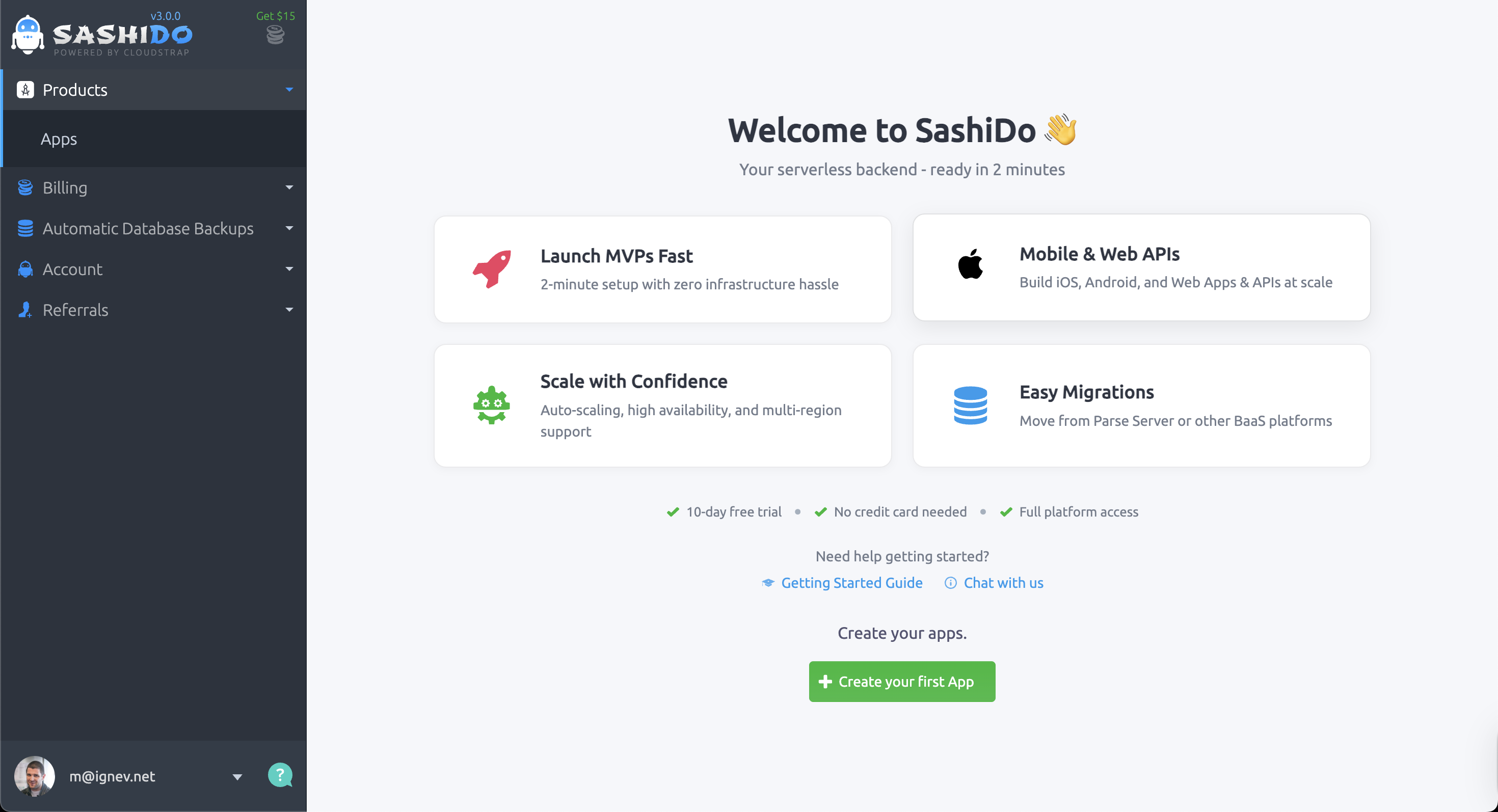
Key questions to think about:
-
Where does your data live?
If you’re working with EU customers, GDPR and data residency matter. You may need 100% EU infrastructure for databases, files, and logs. -
How do you handle real-time data?
RAG on static docs is simple. RAG on live transactional data (orders, events, IoT, analytics) requires a backend that can feed fresh data into your index or prompt reliably. -
Who manages scaling and uptime?
Vector DBs, databases, queues, and workers need monitoring, backups, and scaling. If you don’t have a full DevOps team, a Backend-as-a-Service that’s AI-ready can remove a lot of risk. -
Vendor lock-in
If your core is built around proprietary APIs without an escape hatch, migrations become painful. Using open-source backends and standards-based APIs keeps your options open.
A practical pattern for early-stage teams is:
- Start with a managed backend (auth, database, file storage, background jobs, real-time subscriptions).
Example with SashiDo:
SashiDo provides a fully managed Parse Server backend with built-in authentication, MongoDB database, file storage, and Cloud Code for background jobs-all configured out of the box.
   // Parse Server Cloud Code - Background job for document ingestion
   Parse.Cloud.job("ingestDocuments", async (request) => {
     const { params } = request;
     const documents = await fetchDocumentsFromSource(params.source);

     for (const doc of documents) {
       const Document = Parse.Object.extend("KnowledgeBase");
       const record = new Document();
       record.set("title", doc.title);
       record.set("content", doc.content);
       record.set("embedding", await generateEmbedding(doc.content));
       await record.save(null, { useMasterKey: true });
     }
   });
- Add LLM features behind secure APIs, log usage, and monitor latency and errors.
Example with Parse Server Cloud Functions:
Create secure API endpoints using Parse Cloud Functions with built-in ACL and role-based access control.
   // Cloud Function for LLM query with logging
   Parse.Cloud.define("askAssistant", async (request) => {
     const { user, params } = request;
     if (!user) throw new Error("Authentication required");

     const startTime = Date.now();

     try {
       // Call OpenAI or Anthropic
       const response = await callLLM({
         prompt: params.question,
         userId: user.id
       });

       // Log usage for monitoring
       const QueryLog = Parse.Object.extend("QueryLog");
       const log = new QueryLog();
       log.set("user", user);
       log.set("question", params.question);
       log.set("latency", Date.now() - startTime);
       log.set("tokensUsed", response.usage.total_tokens);
       await log.save(null, { useMasterKey: true });

       return response.answer;
     } catch (error) {
       // Error tracking built into Parse Server
       console.error("LLM Error:", error);
       throw error;
     }
   });
- Introduce RAG once you know which data sources matter, attaching a vector DB and ingestion pipeline to the same backend.
Example integrating Pinecone with SashiDo:
Use Parse Server's webhooks and Cloud Code to connect external vector databases while keeping your core data in Parse.
   // RAG Pipeline with Pinecone integration
   const { Pinecone } = require('@pinecone-database/pinecone');
   const pinecone = new Pinecone({ apiKey: process.env.PINECONE_API_KEY });

   Parse.Cloud.define("ragQuery", async (request) => {
     const { user, params } = request;
     if (!user) throw new Error("Authentication required");

     // Step 1: Generate query embedding
     const queryEmbedding = await generateEmbedding(params.question);

     // Step 2: Retrieve from Pinecone with user's access control
     const index = pinecone.index('knowledge-base');
     const results = await index.query({
       vector: queryEmbedding,
       topK: 5,
       filter: { tenantId: user.get('tenantId') } // Multi-tenant isolation
     });

     // Step 3: Fetch full documents from Parse Server
     const docIds = results.matches.map(m => m.id);
     const query = new Parse.Query("KnowledgeBase");
     query.containedIn("objectId", docIds);
     const documents = await query.find({ sessionToken: user.getSessionToken() });

     // Step 4: Generate answer with context
     const context = documents.map(d => d.get('content')).join('\n\n');
     const answer = await callLLM({
       prompt: params.question,
       context: context
     });

     return {
       answer: answer,
       sources: documents.map(d => ({
         id: d.id,
         title: d.get('title'),
         url: d.get('url')
       }))
     };
   });
- Iterate on retrieval quality (chunking, ranking, filters) without rewriting your whole stack.
Benefits of the SashiDo + Parse Server approach:
- Zero DevOps overhead: SashiDo handles scaling, backups, and monitoring automatically
- Real-time subscriptions: Use Parse LiveQuery to stream updates to your AI features
- Built-in access control: Parse ACLs and roles enforce permissions at the database level
- EU data residency: SashiDo offers EU-hosted infrastructure for GDPR compliance
- Flexible integrations: Connect any vector DB (Pinecone, Weaviate, Qdrant) or LLM provider via Cloud Code
- Open-source foundation: Built on Parse Server, so you're never locked in
This lets you ship features quickly while keeping room to grow into more complex AI infrastructure when you're ready. You can start with simple LLM calls, add vector search when needed, and scale to multi-tenant RAG-all on the same backend without migration headaches.
Challenges and Considerations
No approach is free of trade-offs. Understanding the failure modes early will save you time later.
RAG Pipeline Challenges
-
Infrastructure complexity
You’re adding a vector database, embeddings service, and orchestration on top of your existing backend. That’s more services to secure, scale, and monitor. -
Retrieval quality tuning
Chunk sizes, overlap, filters, and ranking strategies have a big impact on accuracy. Poor retrieval leads to poor answers, no matter how good your LLM is. -
Latency
Each step-embed, search, rerank, generate-adds latency. Without caching and smart routing, UX can suffer. -
Security & access control
If you index sensitive or multi-tenant data, you must enforce permissions when retrieving documents. This typically belongs in your backend and not just in the model prompt.
Traditional LLM Limitations
-
Hallucinations and trust issues
If users expect accurate, verifiable answers, hallucinations can quickly erode trust. -
Out-of-date knowledge
Models trail reality. Even with large context windows, you’re limited by what you can fit in a prompt and keep up to date. -
Cost as you scale
Pushing more data into prompts or fine-tuning to compensate for missing retrieval can quickly become more expensive than maintaining a RAG stack. -
Limited compliance story
Without citations, audit trails, and clear data paths, compliance and enterprise buyers will ask hard questions.
Being explicit about these limits with your stakeholders will help align expectations and roadmap priorities.
Choosing the Right Approach for Your Project
Key Questions to Consider
Use this checklist to quickly assess what you need:
-
How critical is factual accuracy?
-
Mission‑critical, regulated, or customer-facing with real consequences → lean toward RAG.
-
Low‑risk, creative, or internal-only → traditional prompting may be fine.
-
How fast does your knowledge change?
-
Daily/weekly changes in docs, pricing, policies, or data → RAG.
-
Mostly static knowledge → traditional LLM or light fine-tuning.
-
What latency can you tolerate?
-
<300 ms or “instant” feel → traditional LLM, maybe with minimal retrieval.
-
1-2 seconds acceptable for higher accuracy → RAG.
-
What’s your team’s infrastructure capacity?
-
No dedicated DevOps → managed backend plus carefully chosen AI infrastructure.
-
Strong infra team → you can run more components yourself.
-
Where must your data reside?
-
Strict EU data residency / GDPR constraints → prioritize backends and AI infrastructure that operate in those regions.
How to Evaluate Your Needs
A pragmatic decision process for founders and indie devs:
-
Start from user risk, not tech
Map out what happens if the model is wrong: user confusion, support tickets, legal risk, lost revenue. -
Prototype with the simplest setup
For many projects, that means a traditional LLM backend with good logging and observability. -
Instrument everything
Track queries, latency, failure modes, and where users ask for “source” or “proof.” This will tell you when you need RAG. -
Introduce RAG narrowly, where it matters most
Add a RAG Pipeline only for features that truly require up-to-date, verifiable knowledge. Keep creative flows simpler. -
Iterate on infrastructure, not just prompts
As usage grows, you’ll likely need better background jobs, real-time subscriptions, and more robust storage. Choose a backend that can grow with you.
A Practical Path Forward
You don’t have to solve everything on day one. Many successful AI-first products evolve as follows:
-
Phase 1 - Traditional LLM MVP
A simple backend calling an LLM, focused on UX, pricing, and value proposition. -
Phase 2 - Add RAG for critical workflows
Introduce a RAG Pipeline on top of your most important data sources, with proper indexing and access control. -
Phase 3 - Harden the backend
Add rate limiting, audit logs, background processing, and real-time features as usage grows.
If you want to move faster without building all of this from scratch, it’s worth considering a backend that’s already AI-ready, auto-scalable, and built on open-source Parse Server. With managed authentication, databases, real-time subscriptions, background jobs, and EU-native infrastructure, you can plug in RAG or traditional LLM flows without hiring a DevOps team. If that sounds relevant to your roadmap, you can explore SashiDo’s platform as a foundation for your next AI-powered product.
Conclusion: RAG Pipeline, Traditional LLMs, or Both?
A RAG Pipeline is the right choice when your AI application lives or dies on factual accuracy, fresh knowledge, and user trust. Traditional LLM approaches are better when speed, creativity, and low complexity are more important than perfect grounding.
In practice, many serious AI products combine both: RAG for anything that touches real data and decisions, traditional prompting for ideation and low‑risk workflows.
The real differentiator isn’t just which models you choose-it’s how thoughtfully you design your backend, data flows, and AI infrastructure so you can adapt as your product and your users evolve.
If you approach this choice deliberately, your stack can stay flexible: grounded where it must be, fast where it can be, and manageable without a dedicated DevOps team.
🧠 Power Your RAG or LLM App with Zero DevOps Hassles
SashiDo gives you an AI-ready Parse Server backend with real-time subscriptions, background jobs, Cloud Code, and full EU hosting. Easily plug in OpenAI, Pinecone, or any vector DB, and ship faster without infrastructure headaches.
Try SashiDo Free Today