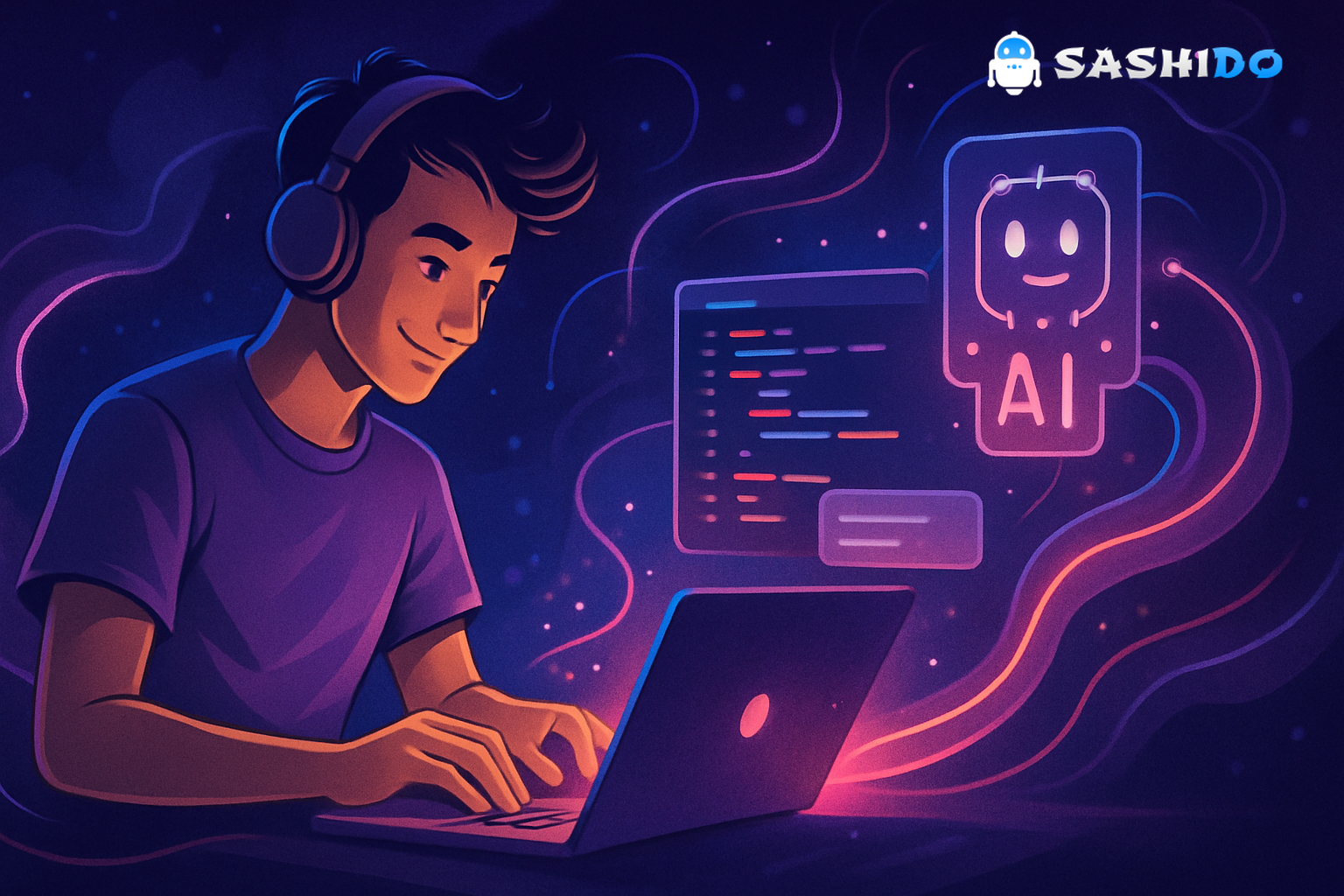
Vibe coding is changing how people write software. Instead of staring at a blank editor and wrestling with syntax, you describe what you want in natural language, get real-time suggestions from AI tools, and refine the result conversationally. Coding starts to feel less like manual labor and more like collaborating with a very fast, always-on pair programmer.
For non-technical founders and indie developers, this is a huge shift. Vibe coding makes it possible to prototype AI-powered products, experiment with ideas, and ship working features without years of programming experience. The key is combining this new workflow with a backend that’s simple to manage, scalable, and ready for AI.
This article breaks down what vibe coding is, how it transforms developer experience, and how to use it responsibly to build real applications-especially if you don’t want to hire a DevOps team.
What is Vibe Coding?
At its core, vibe coding is a style of programming where you:
- Describe intent in natural language ("I need an endpoint that saves chat messages and returns the last 20 for this user").
- Let AI tools generate or refactor the code.
- Iterate through conversational debugging and real-time suggestions.
It’s not a specific product, but a workflow that combines:
- Large Language Models (LLMs) such as those behind tools like GitHub Copilot and Google’s Gemini for developers.
- Tight editor integration (VS Code, JetBrains, browser-based IDEs).
- Chat-style interfaces where you can ask, "Why is this failing?" instead of searching docs for an hour.
How Vibe Coding Feels in Practice
Traditional coding:
- You look up API docs.
- You Google errors.
- You copy/paste snippets from Stack Overflow.
- You fight with build tools, configuration, and syntax.
Vibe coding:
- You explain the vibe of what you want ("simple login with email, magic link, and basic rate limiting").
- The AI generates starter code for your backend route, database calls, or UI component.
- You ask follow-up questions in plain language: "Make this work with JWT" or "Use MongoDB instead of SQL".
- The AI updates the code and explains what changed.
The result: you focus more on the product and the user experience, less on memorizing APIs.
How Vibe Coding is Transforming Developer Experience
Developer experience used to be defined by your tools (IDEs, debuggers, frameworks). Now it’s shaped by how effectively AI can work alongside you.
Studies already show that AI-assisted development can significantly improve productivity. GitHub has reported that Copilot users often complete tasks noticeably faster and with higher satisfaction compared to traditional coding alone, especially on boilerplate-heavy work (GitHub Copilot). McKinsey similarly highlights generative AI as one of the biggest levers for developer productivity in the coming decade (McKinsey on developer productivity).
In a vibe coding workflow, real-time suggestions and conversational assistance affect developer experience in a few key ways:
- Less friction: You spend less time stuck on syntax or APIs and more time exploring ideas.
- Faster feedback loops: You can ask, "Refactor this for performance" and instantly see alternatives.
- Lower cognitive load: You don’t have to keep the entire framework in your head-AI tools can remind you of patterns and best practices.
- More experimentation: It becomes cheap to try three or four different approaches and keep the one that feels right.
This doesn’t replace engineering discipline-but it does make the journey more playful and creative.
Here’s a thought-provoking read: this post breaks down why the old “cheap, fast, quality” trade-off no longer holds up. It explores how vibe coding and modern tooling let small teams ship faster without sacrificing quality.
The Benefits of Vibe Coding for Beginners
If you’re a non-technical founder or a new indie dev, regular programming can feel intimidating: weird syntax, cryptic errors, and a mountain of tooling. Beginner-friendly coding with vibe-based workflows lowers that barrier.
Instant Feedback and Fewer Dead Ends
In traditional learning, you might:
- Spend hours trying to debug a missing semicolon.
- Give up because a tutorial is outdated.
With AI-assisted development and vibe coding:
- You paste your error into an AI assistant and ask, "What does this mean and how do I fix it?"
- You request, "Explain this function like I’m new to JavaScript," and get a human-readable breakdown.
- You can ask, "Is there a simpler way to do this?" and get an alternative.
This makes coding more forgiving and keeps you motivated.
Natural-Language Onboarding
Instead of memorizing framework docs, you can:
- Ask, "Show me how to create a user with email and password using Parse Server."
- Follow with, "Now add a rule so only the creator can read their own data."
The AI handles the boilerplate, while you learn by reading and tweaking real, working code.
Safer Exploration
Because AI tools can explain what they’re doing, beginners have a chance to:
- Learn secure patterns for authentication and authorization.
- Avoid some common mistakes (like exposing secrets in the frontend).
- Get reminders about rate limiting, validation, and error handling.
Of course, you still need to review and understand the generated code-but the ramp-up is far less brutal than doing everything manually.
Enhancing Productivity with Vibe Coding
For experienced developers and serious indie makers, coding productivity is less about writing more code and more about shipping value faster.
Vibe coding helps by:
- Automating boilerplate: CRUD handlers, validation layers, client SDK setup.
- Suggesting optimizations: "Can you make this query more efficient?" or "Rewrite this for better readability."
- Generative scaffolding: You describe the architecture; the AI drafts your models, routes, and cloud functions.
Surveys like the Stack Overflow Developer Survey 2024 show that a growing majority of developers are already using AI tools daily. The culture of software development is shifting from lone problem-solving to continuous collaboration with AI.
From a team perspective, this changes software development culture as well:
- Code reviews focus more on architecture and trade-offs, less on minor style issues.
- Juniors can contribute sooner because they get help in real time.
- Product teams can validate ideas with real prototypes in days, not weeks.
If you’re curious how far AI agents can take you, check out this real-world story of shipping an MVP on SashiDo using vibe coding. It follows a non-developer’s journey from idea to working product with AI in the loop.
From Vibe to Production: Why Your Backend Still Matters
Vibe coding can help you write code faster, but it doesn’t remove the hard requirements of running a real product:
- Data must be stored securely and reliably.
- Users expect authentication, permissions, and real-time updates.
- AI features need low-latency APIs and scalable infrastructure.
- If you’re in Europe, GDPR and data sovereignty aren’t optional.
This is where pairing vibe coding with the right backend platform matters.
Here’s a useful read if you’re shipping a mobile app that handles personal data: this article walks through how to get GDPR-ready with real examples. A great reference for balancing compliance with a smooth user experience.
The Backend Problems Vibe Coding Won’t Solve Alone
Even with AI tools, someone still has to:
- Configure a database and keep it running.
- Secure your API endpoints and manage authentication flows.
- Scale servers when you hit traffic spikes.
- Keep latency low for chatbots, AI assistants, and real-time dashboards.
Non-technical founders rarely want to hire a dedicated DevOps team just to keep the lights on. That’s why many teams combine vibe coding on the frontend and cloud code with a Backend-as-a-Service (BaaS) or managed Parse Server infrastructure, like SashiDo, on the backend.
A good backend platform for vibe coding should:
- Be AI-ready (easy to integrate LLMs, webhooks, and external APIs).
- Offer auth, database, files, and real-time subscriptions out of the box.
- Provide auto-scaling so you don’t worry about traffic spikes.
- Avoid vendor lock-in by being open-source-friendly.
- Offer GDPR-native, regional hosting if you’re serving European customers.
When your backend gives you these primitives, you and your AI assistant can focus on writing business logic and product features-not reinventing infrastructure.
A Simple Blueprint: Build an AI-Powered App with Vibe Coding
Let’s walk through a concrete, high-level workflow you can adapt as a non-technical founder or indie dev.
1. Define the User Experience in Plain Language
Write a short spec in natural language, for example:
"I want a web app where users can log in, chat with an AI assistant about their startup idea, and save favorite conversations. I need email login, GDPR-compliant data storage in the EU, and basic usage limits per user."
This becomes the starting prompt for your AI coding assistant.
2. Vibe-Code the Frontend
Using your favorite stack (e.g., React, Vue, Svelte, or a no-code/low-code builder that supports custom code):
- Ask your AI tool: "Generate a simple login page and chat UI with message bubbles."
- Iterate until the layout matches the user experience you want.
- Have the assistant wire up basic state management and form handling.
You don’t need to fully understand every library from day one-you can ask the AI to explain pieces as you go.
3. Use Vibe Coding for Cloud Logic
Where things get powerful is combining vibe coding with cloud-side logic:
- Ask the AI to write a cloud function that:
- Receives a chat message.
- Calls your chosen LLM API.
- Stores the conversation in your backend database.
- Streams or returns the answer to the client.
Here you lean on AI to draft the integration, then adapt it to your specific backend platform (e.g., Parse Server cloud code, Node.js functions, or serverless functions).
Here’s a useful reference if you want to keep your business logic clean and centralized: this part of the SashiDo getting started guide shows how to write and deploy Cloud Code. A great read for adding server-side functionality to your app without managing your own servers.
4. Wire in Auth, Permissions, and Limits
Next, describe your security rules in natural language:
- "Only the owner of a conversation can read or delete it."
- "Guests can try three messages; signed-in users get more."
Ask your AI assistant to:
- Implement these rules using the backend’s permission system.
- Add basic rate limiting.
- Provide tests or example requests verifying it works.
This is where working with a backend that has class-level permissions, real-time subscriptions, and a friendly database browser can save you hours.
5. Test, Iterate, and Observe
Finally:
- Use AI tools to generate test cases.
- Simulate high load or many conversations.
- Check logs and metrics from your backend platform.
Thoughtworks has emphasized in its Technology Radar that AI-assisted development is most effective when paired with good engineering practices like automated testing and observability. Vibe coding should help you move faster and build more reliable systems-if you use it intentionally.
Risks and Trade-Offs of Vibe Coding (And How to Mitigate Them)
Vibe coding is powerful, but it’s not magic. There are real trade-offs worth understanding.
Risk 1: Shallow Understanding of Your Own Code
If you just accept whatever the AI generates, you can end up with a codebase that nobody truly understands.
Mitigation:
- Ask "Explain this function step by step" for complex parts.
- Regularly refactor with the AI as your assistant, not your replacement.
- Keep core business logic small, clear, and well-documented.
Risk 2: Hidden Security and Compliance Issues
LLMs do not inherently know your regulatory context. If you serve EU users, for instance, GDPR and data residency matter-a lot.
Mitigation:
- Decide up front where your data must live (e.g., 100% EU infrastructure).
- Use platforms and databases that support regional hosting and strong access control.
- Have AI explain security implications of code changes and review them yourself.
Resources from organizations like the European Data Protection Board and national DPAs can help you understand your obligations.
Risk 3: Vendor Lock-In
Many AI-centric platforms encourage you to build directly on proprietary stacks that are hard to leave.
Mitigation:
- Favor open-source backends and portable architectures.
- Keep your data in formats and databases you control (e.g., direct MongoDB access).
- Treat proprietary tools as helpers, not the foundation of your system.
Risk 4: Over-Reliance on One AI Tool
Relying entirely on a single provider can backfire if pricing, rate limits, or capabilities change.
Mitigation:
- Abstract AI calls behind your own API layer or cloud code.
- Design your backend so you can swap LLM providers with minimal changes.
- Follow multi-provider best practices highlighted by industry analysts like MIT Technology Review when evaluating AI infrastructure.
Turning Vibes into a Scalable Product
If you’re building in Europe-or serving European customers-you face an extra constraint: data sovereignty. You want the speed and playfulness of vibe coding, but you also need:
- 100% EU infrastructure.
- GDPR-native design.
- A backend that supports AI workloads, real-time features, and global scaling-with no DevOps team.
For founders and indie devs in this situation, one practical path is to combine:
- Vibe coding on the frontend and in cloud code using modern AI assistants (including specialized "vibe coding" GPTs for your stack).
- A managed, auto-scalable Parse Server backend that handles auth, database, files, real-time LiveQueries, background jobs, and web hosting, while giving you direct MongoDB access and no vendor lock-in.
If you’re experimenting with AI-powered apps and want to move from prototypes to production without hiring an ops team, it can be worth taking a look at platforms that provide this kind of Parse-based, AI-ready infrastructure. For example, you can explore SashiDo’s platform for EU-native Parse Server hosting, real-time backends, and AI-friendly cloud code that pairs naturally with vibe coding workflows for founders and indie developers: explore SashiDo’s platform.
Vibe Coding and the Future of Software Development
Vibe coding isn’t a passing trend; it’s a reflection of a deeper shift in how software gets made. As AI tools mature and become more tightly integrated into our editors, CI/CD pipelines, and backends, we’ll see:
- More non-traditional developers-founders, designers, operators-contributing directly to product code.
- Faster cycles from idea to prototype to production.
- A stronger focus on architecture, data models, and compliance, while AI handles much of the implementation detail.
For non-technical founders and indie developers, this is an opportunity. By combining vibe coding with a solid, AI-ready backend that respects data sovereignty and removes DevOps overhead, you can move at startup speed without sacrificing reliability or compliance.
The challenge isn’t just to vibe-code something that works today-it’s to build on an infrastructure that will scale with you tomorrow. Get that foundation right, and vibe coding becomes more than a fun way to program; it becomes your competitive edge.
🎯 Vibe Code Your App. SashiDo Handles the Rest.
SashiDo gives you a production-ready Parse Server backend with real-time features, Cloud Code, background jobs, and full EU hosting. Perfect for turning your AI-powered prototype into a scalable product - no DevOps experience required.
Try SashiDo Free Today