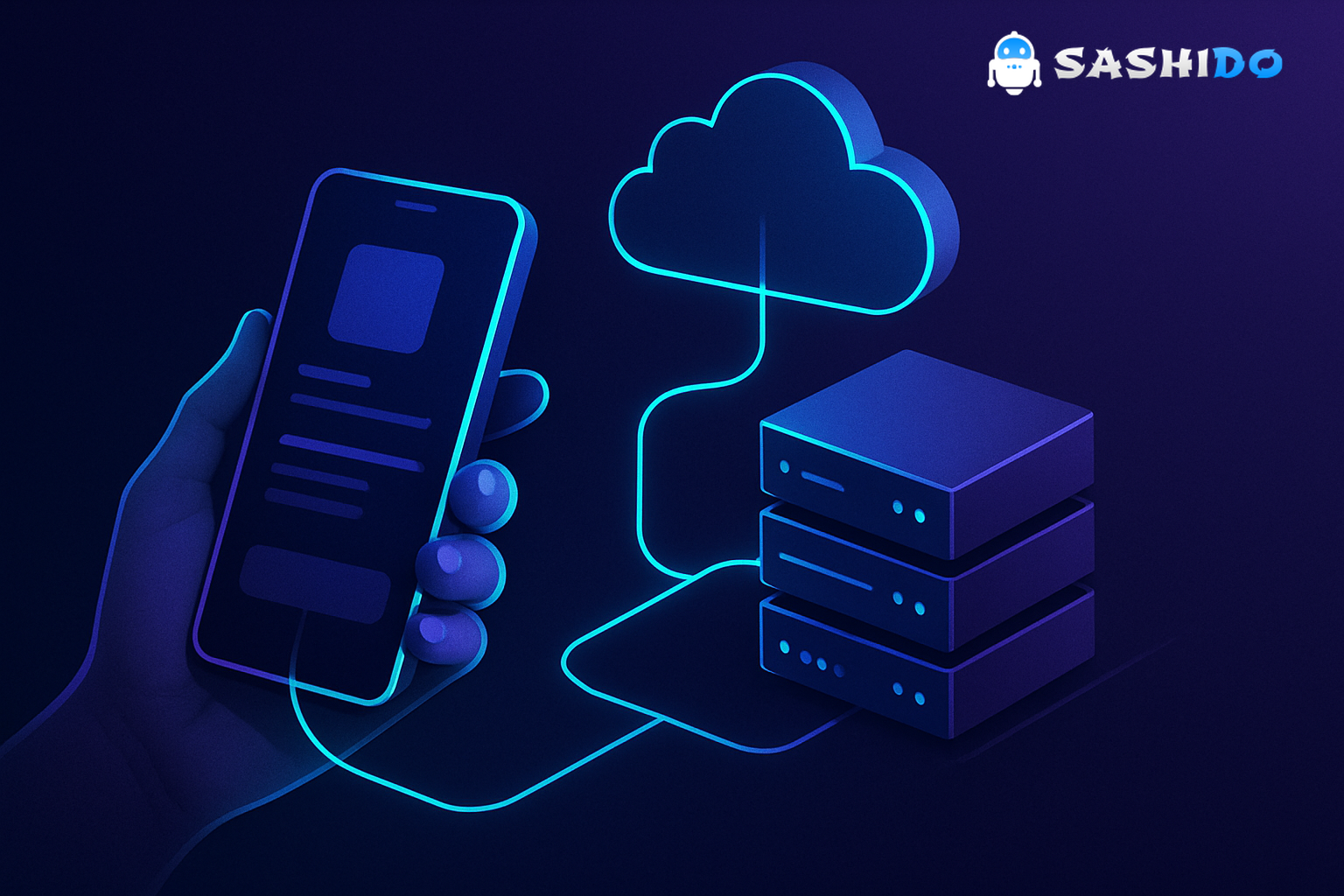
If you have ever shipped a mobile app and thought, “the UI is the fun part, the backend is where weekends go to die,” you are not alone. The moment you add auth, push notifications, file uploads, background jobs, and anything that feels like a live database, you are suddenly running a small production system.
That is why how to build a backend for a mobile app often becomes less about database tables and more about avoiding infrastructure work you did not sign up for. For solo indie developers and side project builders, the winning pattern is simple. Pick a backend approach that lets you move fast today, but does not punish you when you hit 1,000 to 10,000 monthly active users.
Serverless backend platforms exist because most apps need the same behind-the-scenes capabilities, and most teams do not want to become on-call SREs to get them. When server management fades into the background, you get back to what actually grows the app. Shipping features, validating ideas, and iterating with users.
What “Serverless” Actually Means in Practice
Serverless does not mean there are no servers. It means you are not responsible for provisioning them, patching them, scaling them, or waking up to alarms when a node runs out of disk. The platform still runs servers. It just treats them like a managed utility so you can treat your backend as a product component instead of a second job.
In real projects, “serverless” becomes noticeable when you hit the first messy moment. A launch post lands. A store features you. A subreddit picks up your app. The backend either absorbs the spike or becomes the thing you are frantically fixing while users bounce. A serverless backend platform is designed to absorb that moment with automatic scaling and managed operations, which is exactly how major cloud providers frame the model. You write the application logic. The provider handles the infrastructure lifecycle.
A useful mental model is the difference between “owning a server” and “consuming backend capabilities.” You stop thinking about instance size and start thinking about API behavior, latency, and data access patterns. This is also where the best platforms set expectations clearly. You get guardrails, reasonable defaults, and enough visibility to debug.
If your priority is shipping an MVP fast while keeping ops close to zero, you can start with a managed Parse backend on SashiDo - Parse Platform and keep your focus on the app experience.
Less Worry, More Building: The Real Cost of Traditional Backends
Most indie projects do not fail because the founder could not write code. They fail because execution time gets eaten by a long tail of operational tasks. SSL renewals, database backups, monitoring, log storage, container updates, security patches, rate limiting, and “why is production slow at 2 a.m.?”
Even if you are comfortable with cloud infrastructure, the opportunity cost is brutal. Every hour spent on “keeping it alive” is an hour not spent improving onboarding, pushing retention features, or responding to user feedback. And unlike product work, ops work often arrives as interruptions that break momentum.
The hidden cost also shows up as risk. When you are solo, a backend outage is not “an incident.” It is a day lost. It is reviews dropping. It is a support queue you now have to clear. Serverless platforms shift a big portion of that risk onto a system that is designed to handle it.
From a security standpoint, the risk reduction matters too. APIs are now the core attack surface for many apps, and common failure modes are well documented. If you have not skimmed the OWASP API Security Top 10, it is worth it because it maps directly to day-to-day backend mistakes. Broken authorization. Excessive data exposure. Improper asset management. A managed platform cannot magically secure everything, but it can reduce the number of moving parts you need to harden.
Built to Grow With You: Scaling That Does Not Force a Rewrite
Scaling is rarely about “we need more CPU.” It is about the app suddenly behaving differently. More concurrent sessions. Larger datasets. More writes per minute. More background tasks. More push notifications. More queries that were fine at 100 users but fall apart at 5,000.
A common trap is starting with a backend that works for a prototype, then discovering the platform has sharp limits. Maybe a hard cap on requests. Maybe pricing that jumps because the billing unit is not aligned with how your app uses the backend. Maybe real-time features are an add-on that forces an architectural pivot.
A serverless backend platform is valuable when it lets you keep your app-level contracts stable as you grow. Your clients keep calling the same API endpoints. Your auth flows stay intact. Your data model evolves without forcing a migration off the platform.
This is also where vendor lock-in becomes a real, non-academic concern. If your backend uses proprietary APIs that cannot be reproduced elsewhere, you are trading speed today for a forced rewrite later. For a side project, that rewrite often never happens. The project just stalls.
How to Build a Backend for a Mobile App With a Serverless Platform
The practical path looks the same across most mobile app backend services, even if the brand names differ. You start with a managed data layer, expose it through secure APIs, add auth, then layer in real-time and background work.
The difference is in the defaults and the escape hatches.
Start With a Managed Data Layer That Can Act Like a DB as a Service
A mobile backend needs to store structured data, handle relations, enforce access rules, and stay consistent as your app evolves. In the early stage, you want a DB as a service experience. Provisioning is quick. Backups are handled. Basic observability exists. The schema can evolve without you writing a lot of plumbing.
In practice, this is what saves time. When you add a feature like favorites, comments, or user profiles, you do not want to spin up new infrastructure. You want to model the data, ship the UI, and iterate.
The rule of thumb we see with solo builders is that you should treat your backend as an API product. That means you care about:
- predictable read and write paths
- access control that matches your auth model
- query patterns you can reason about as the dataset grows
- backups and data export so you can leave if you need to
Add Authentication and Access Control Early, Not After Growth
Auth is usually the first “backend reality check.” It is easy to get login working. It is harder to ensure users only see what they are allowed to see, at every endpoint, for every client version.
The pattern that holds up is to define access rules alongside your data model, not as a separate layer of custom endpoints. When you do that, you reduce the surface area for “oops, we shipped an admin-level response to all users.” And you make it easier to change policies later.
This is also where following established operational principles pays off. The Twelve-Factor App is not mobile-specific, but its guidance around config, backing services, and deployment discipline is a good sanity check when your side project turns into something people depend on.
Scale by Default, but Keep Cost Predictable
Serverless scaling is great when it is boring. The goal is not to “scale to infinity.” The goal is to avoid having to babysit scaling decisions while you are trying to learn what your users want.
For indie budgets, what usually breaks is not the spike itself. It is the bill. This is why it helps to pick a platform where pricing aligns with usage patterns you can anticipate. Storage grows as your users upload. Compute grows as you add background work. Data transfer grows as your app becomes more real-time.
If you have ever watched a hobby project become expensive right when it starts to work, you already know the pain. Some platforms feel great until you cross a threshold, then costs jump and the limits appear. If you are currently evaluating Firebase-style models, it is worth reading a platform comparison that focuses on scaling behavior and request limits rather than marketing headlines. Our breakdown in SashiDo vs Firebase is written for that “this is growing and I need predictability” moment.
Real-Time, All the Time: When Your Backend Needs to Feel Live
Users now expect apps to feel responsive in a very specific way. A message appears instantly. A delivery status updates. A friend’s location changes. A scoreboard refreshes without a pull-to-refresh gesture. That is the “live database” expectation.
Technically, real-time is a set of trade-offs. You are maintaining persistent connections, deciding when to push versus poll, and dealing with the fact that mobile networks are unreliable. This is why built-in real-time capabilities are so valuable. They remove a whole category of glue code that is easy to get wrong.
When you implement real-time from scratch, you usually end up standing on WebSockets or similar streaming primitives, and the specification is not complicated but the operational side is. Connection limits, heartbeats, retries, and load balancing all show up quickly. If you want to understand the foundation, the WebSocket protocol (RFC 6455) is the canonical reference.
In a serverless backend platform, real-time features are most useful when they are integrated with your data model and permissions. It is not enough to “stream updates.” You need to stream the right updates to the right users, without leaking private data.
This is a common moment where side projects stall. The app is working, but the real-time layer becomes fragile. Chat becomes inconsistent. Notifications are delayed. Collaborative features drift out of sync. A managed real-time layer can be the difference between shipping the feature in a weekend and spending two weeks debugging reconnection edge cases.
The Big Win: Your Time and Attention Come Back
The biggest value of serverless is not that it is trendy. It is that it changes what you spend your attention on.
When you do not manage infrastructure, you make different product choices. You ship smaller increments because deploying is not scary. You test ideas quickly because you are not blocked on ops chores. You keep momentum because your evenings are not filled with “just one more fix.”
This also reduces the kind of burnout that shows up as silent quitting on your own project. The project is not dead. You are just tired of maintaining it. Serverless platforms remove a lot of the repetitive stress, particularly around scaling events and reliability work.
If you want a concise definition of the model and why it became mainstream, the AWS overview of serverless computing is a good baseline. Even if you do not use AWS directly, it captures the core idea. You stop managing servers. You focus on application behavior.
Where Serverless Backends Shine, and Where They Do Not
Serverless is not a universal answer. Knowing where it fails is part of using it well.
Serverless backends shine when you need to ship quickly, when your load is uncertain, and when the backend features you need are common patterns: authentication, CRUD APIs, file storage, scheduled jobs, push notifications, and real-time updates. That is most mobile and web apps.
They can be a poor fit when you need extremely specialized networking, strict data residency controls that the platform cannot satisfy, or deeply custom infrastructure. They can also be limiting if you require non-standard databases, unusual runtime dependencies, or a very specific observability stack.
Another real constraint is portability. Some “serverless” products are effectively proprietary frameworks. You can build quickly, but you cannot leave without a rewrite. If your project is likely to become a business, that trade-off deserves attention early.
The CNCF perspective on serverless is a useful lens here because it treats serverless as part of a larger cloud-native ecosystem. In other words, serverless is a productivity model. You still need to understand architecture basics so you can make good trade-offs.
A Practical Checklist for Choosing the Best Backend-as-a-Service for Startups
When people search for the best backend-as-a-service for startups, they are usually trying to avoid two outcomes. Getting stuck in infrastructure work, or getting trapped in a platform that becomes expensive or restrictive right when the app starts working.
Here is a practical way to evaluate options without drowning in feature matrices.
First, look at the “day one” path. Can you stand up a backend server for mobile apps in under an hour, including authentication and a basic data model. If the setup feels heavy now, it will feel worse when you are tired.
Next, check real limits, not just headline features. Does pricing punish you for high request volume. Does the platform impose caps that make sense for demos but not for real usage. This matters for side projects that may never monetize but still need to be reliable.
Then, check export and migration paths. Can you export your data in a usable format. Can you move your backend logic somewhere else if you outgrow the platform. If you cannot leave, you are not choosing a tool. You are choosing a long-term dependency.
Finally, evaluate the real-time story. If you will ever build chat, live tracking, collaborative editing, or instant notifications, make sure the platform has a clear path. Either built-in real-time, or an integration that does not require you to redesign the app.
Where We Fit: An Open-Source-Based Serverless Backend You Can Grow With
Once the basic idea is clear, here is how we think about the “serverless backend platform” job.
We built SashiDo - Parse Platform for developers who want the speed of a managed backend without being boxed in by proprietary constraints. Under the hood, we lean on the open-source Parse Server ecosystem so you can keep portability in your back pocket, even if your side project turns into a serious product.
In practice, that means you can treat us as your backend foundation while you stay focused on the app. We handle the operational work that usually drains solo builders. Scaling, maintenance, and the boring reliability tasks. We also keep pricing transparent and aligned with real usage, and we avoid the typical “request cap” ceiling by supporting unlimited API requests.
Just as importantly for modern apps, the backend is no longer only about CRUD. Many teams are building AI-powered experiences, from ChatGPT-style app features to MCP-compatible services and LLM workflows. A serverless backend platform should not make that harder. It should give you stable APIs, secure data access, and predictable deployment so you can iterate on AI features without rebuilding your infrastructure every time you change direction.
Conclusion: Ship Faster, Then Scale Without Rebuilding
If you are deciding how to build a backend for a mobile app, the most helpful frame is to optimize for momentum and survivability. Momentum means you can ship the next feature without getting dragged into ops. Survivability means you can handle growth without rewriting your backend or accepting surprise limits.
Serverless backend platforms are valuable because they move backend infrastructure out of your daily life while keeping the core capabilities close. Managed data. Secure APIs. Real-time updates. Scaling that does not require a weekend of firefighting.
When you are ready to move from prototype to production without surprise bills, explore SashiDo - Parse Platform to start a free project, connect your GitHub repo, and deploy an auto-scalable Parse Server backend with real-time LiveQueries and transparent pricing.
FAQs
Is serverless the same thing as Backend-as-a-Service?
Not always. Serverless describes an operational model where you do not manage servers, while BaaS describes a product category that bundles backend features like auth, database, and APIs. Many BaaS products are serverless, but some serverless setups are assembled from multiple services.
Do serverless backends work for real-time apps like chat?
Yes, if the platform provides built-in real-time capabilities or a clean integration path. The hard part is not only pushing updates, it is doing it reliably on mobile networks while respecting permissions and handling reconnections.
What is the biggest risk with many mobile app backend services?
Lock-in and cost surprises are the most common. If your backend uses proprietary APIs and billing units that do not match your usage, you can end up forced into a rewrite right when the app starts growing.
When should I avoid a serverless backend platform?
Avoid it when you need very specialized infrastructure control, strict residency guarantees a platform cannot meet, or a highly custom runtime environment. In those cases, the flexibility of self-managed infrastructure may be worth the ops overhead.
Can I keep portability while using a managed platform?
Yes, if the platform is built on an open-source foundation and supports data export and standard APIs. For example, SashiDo - Parse Platform is built around an open-source Parse Server ecosystem, which helps keep migration options practical.
Sources and Further Reading
- AWS: What Is Serverless Computing? . Helpful baseline definition and benefits framed around developer productivity and scaling.
- OWASP API Security . A practical list of common API failure modes that show up in real mobile backends.
- The Twelve-Factor App . A lightweight set of operational principles that help projects scale without chaos.
- RFC 6455: The WebSocket Protocol . Canonical reference for the protocol most real-time systems build upon.
- CNCF on Serverless Computing . Useful ecosystem view of serverless as a cloud-native productivity model.
